
How ChatGPT Search and Perplexity are Changing SEO
Explore how ChatGPT Search and Perplexity are transforming the SEO landscape. Learn new optimization strategies to stay visible in AI-powered search engines.
SEO & DIGITAL MARKETING
Video Guru
6/10/20263 min read
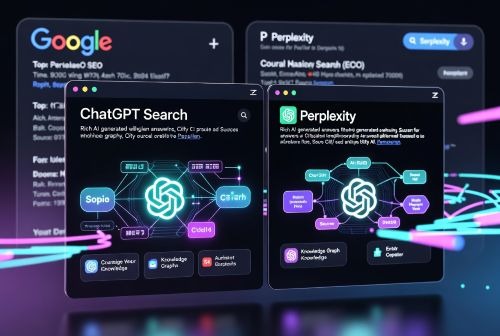
The search landscape is undergoing its most profound transformation since Google’s dominance began. Traditional keyword-based search engines are being complemented — and in some cases challenged — by AI-powered platforms that deliver synthesized, conversational answers rather than lists of links.
Leading players like ChatGPT Search, Perplexity, Gemini, and Copilot are redefining how users find information. This analysis explores these emerging AI search engines, their underlying technology, and how brands and agencies can earn meaningful citation share in this new environment.
The New Generation of AI Search Engines
Perplexity pioneered the modern AI search experience with its focus on transparency and real-time web access. It combines conversational interfaces with clear source citations, making it popular among researchers and professionals who value accuracy and traceability.
ChatGPT Search (OpenAI’s integrated search feature) brings the power of GPT models directly to web queries, delivering natural, context-aware responses while maintaining conversation history across sessions.
Gemini (Google) leverages Google’s vast index and real-time capabilities, often appearing in AI Overviews within traditional Google Search. It excels at multimodal understanding and integration with Google’s ecosystem.
Copilot (Microsoft) deeply integrates with Bing’s index and Microsoft’s productivity tools, making it particularly strong for professional and enterprise users who need answers connected to work contexts.
All of these platforms rely on Large Language Models (LLMs) as their core reasoning engine, but they go far beyond simple text generation.
Retrieval-Augmented Generation (RAG): The Technology Behind Citations
The breakthrough enabling reliable AI search is Retrieval-Augmented Generation (RAG).
Here’s how it works in practice:
Retrieval Phase: When a user asks a question, the system first searches the web (or a curated index) for relevant documents and passages.
Augmentation Phase: The retrieved information is fed into the LLM alongside the user’s query.
Generation Phase: The model generates a coherent, natural-language response while citing or referencing the most relevant sources.
This architecture is what allows Perplexity, ChatGPT Search, Gemini, and Copilot to provide cited answers instead of hallucinated information. RAG dramatically improves factual accuracy and enables transparent citation share — showing users exactly which sources contributed to the answer.
For brands and agencies, this means visibility is no longer just about ranking on a SERP. It’s about becoming a citation-worthy source that AI systems choose to reference when generating responses.
How Agencies Earn Visibility and Citation Share
To succeed in AI search environments, agencies must shift from traditional link-building tactics to creating genuinely citation-worthy content. Here’s how top performers are doing it:
1. Producing Original, Non-Commodity Insights AI systems favor unique data, proprietary research, fresh analysis, and expert perspectives. Generic “how-to” guides or aggregated information are less likely to be cited because they can be synthesized from multiple sources. Agencies should focus on creating original benchmarks, surveys, case studies with exclusive metrics, and forward-looking analysis.
2. Building Strong Entity Authority Clear, consistent entity signals (brand, people, products, concepts) help AI models understand and accurately represent your information. This includes structured data, authoritative author profiles, and interconnected content clusters.
3. Optimizing for RAG Compatibility Content should be:
Clearly structured with descriptive headings
Rich in specific, verifiable facts and data
Written in a natural, authoritative tone
Supported by transparent methodology and sourcing
4. Earning Multi-Platform Citations Agencies that secure coverage across traditional media, industry publications, and high-authority sites increase their chances of being referenced by multiple AI engines. Strong citation share across platforms compounds visibility.
Practical Strategies for Citation-Worthy Content
Conduct original research and publish findings with detailed methodology
Create in-depth comparisons and benchmarks that others reference
Develop tools, calculators, or resources that solve specific industry problems
Publish expert commentary and predictive analysis on emerging trends
Build transparent case studies with real metrics and lessons learned
The Measurement Framework for AI Visibility
Agencies should track:
Frequency of citations in major AI platforms
Citation share within specific topics or queries
Brand mention volume in generative responses
Click-through traffic from AI features
Changes in traditional organic performance as AI adoption grows
Challenges and Considerations
While AI search offers new opportunities, it also presents challenges:
Reduced click-through rates if users get complete answers directly in AI responses
Increased competition for high-quality, original content
Greater emphasis on E-E-A-T and source trustworthiness
Rapid evolution of platforms requiring continuous adaptation
In the age of AI search engines, citation share is becoming as important as traditional rankings. Platforms like ChatGPT Search, Perplexity, Gemini, and Copilot use retrieval-augmented generation to deliver cited, synthesized answers. Brands that consistently produce original, high-value insights and data are far more likely to earn prominent placement in these responses.
The agencies that thrive will be those that help clients create genuinely citation-worthy content while maintaining strong technical foundations and ethical practices. The future of visibility belongs to organizations that don’t just optimize for search engines — they optimize for being trusted sources that AI systems confidently reference.
Success in this new era requires a fundamental shift: from competing for clicks to becoming a foundational part of the knowledge ecosystem that powers AI answers.